
Building Science Research at Services ecoPlus
At Services ecoPlus, applied building science research draws on observations from interventions, measurements and analyses carried out in real buildings. As building systems analysts, we study the phenomena that influence their performance, durability and occupants’ health.
Our work is organized around three complementary levels: matter, to understand materials and heat, air and moisture transfer; system, to analyze interactions among the envelope, mechanical systems, uses and climate; and data, to transform observations into knowledge, models and decision-support tools.
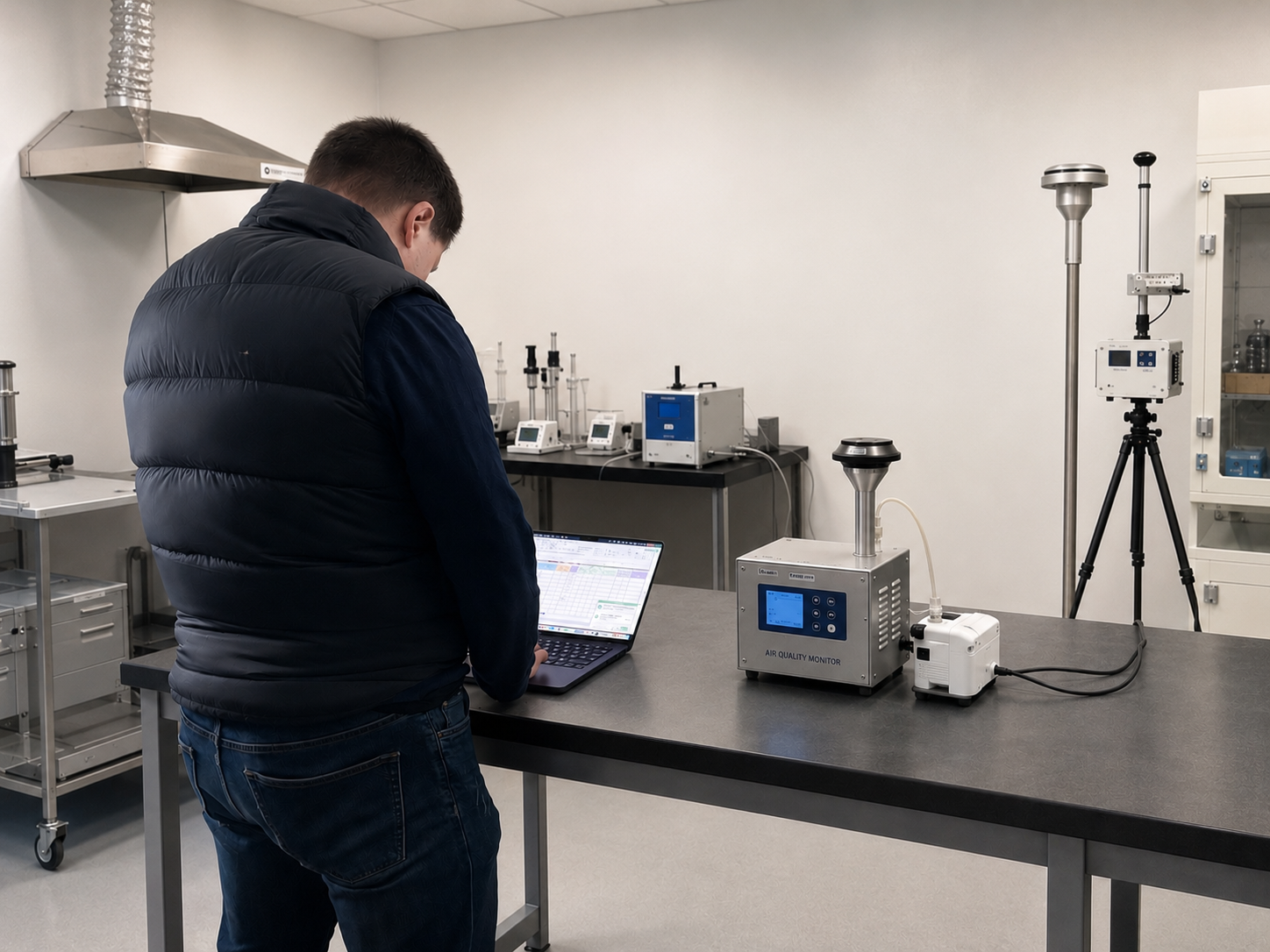

Our approach
Understanding the building as a system
Much specialized research isolates phenomena: indoor air quality on one side, energy performance on the other. Our work starts from occupied buildings, where moisture, ventilation, airtightness, insulation, use patterns and mechanical systems constantly interact.
Our approach combines scientific rigour with practical building knowledge to identify patterns from field observations. This allows us to study buildings as complete systems, where occupant health, energy performance, comfort and durability need to be understood together.
Research framework
Matter, system and data
Services ecoPlus structures its applied research around three complementary levels. Matter addresses materials and physical transfer mechanisms; system considers the building and interactions among its components; and data brings together data science, artificial intelligence and digital tools.
Together, these levels support a systems understanding of real buildings and connect field observations with physical mechanisms, operating conditions and evidence-based decisions.
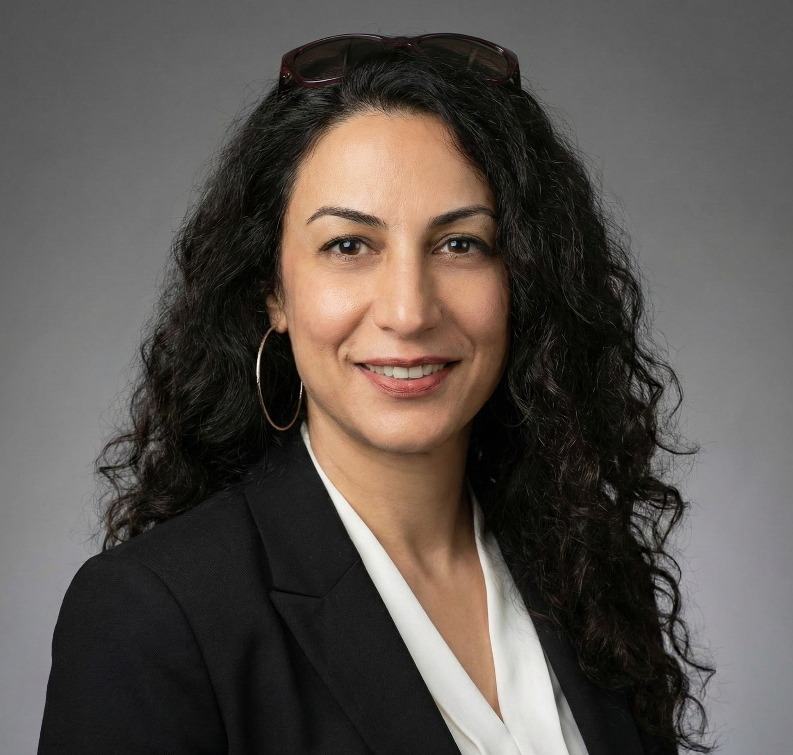
Dr. Mitra Bahri
Our research program is led by Mitra Bahri, who holds a Ph.D. in Civil and Environmental Engineering with a specialization in indoor air quality.
Mitra has devoted more than ten years to this field, notably at the National Research Council of Canada (NRC), where she led research projects on building materials and their effect on the air we breathe. Over the course of her career she has authored more than ten peer-reviewed articles and serves as an invited reviewer for leading international journals in the built environment.
She has contributed to the development of national and international standards: she previously co-chaired the Canadian Committee on Indoor Air Quality (CCIAQ) and served as a voting member on the Standards Council of Canada’s mirror committee for ISO/TC 142. She is also a member of ASHRAE and the IAQA.
At Services ecoPlus, Mitra works both as a technologist — field surveys, sampling, energy modelling, report writing and client advisory — and as the lead of our research program.

Julien Chaput-Lemay
Services ecoPlus’ research approach is also shaped by Julien Chaput-Lemay, the company’s owner and leader since acquiring it in 2021, and a citizen-researcher involved in developing methods, tools and research questions that emerge from field practice.
His background combines entrepreneurship, technical building diagnostics, a varied academic path and written reflection on issues related to the built environment. This position allows him to connect the daily observations of field teams, client needs, the company’s accumulated data and knowledge from academic research.
In exploratory energy-efficiency projects, Julien brings the perspective of a practitioner-researcher: observing what existing buildings reveal under real operating conditions, then turning those observations into better questions. This approach helps ecoPlus Services treat renovation not only as a technical exercise, but also as a social, financial and operational reality where building health, comfort, durability and implementation feasibility must be considered together.
Data Foundation
More than 15 years of longitudinal data
The Services ecoPlus research corpus includes more than 15,000 reports produced over more than 15 years of field work and analysis. It covers residential, commercial, industrial and institutional buildings under real occupancy and operating conditions.
These reports include energy-efficiency assessments, indoor air quality studies, mould investigations, and material characterizations involving asbestos, lead and other substances. This longitudinal depth makes it possible to study how phenomena evolve, how building systems interact, and which patterns cannot be identified from isolated observations.
Our Data Foundation Includes
Building Types
Residential, commercial, industrial and institutional buildings observed under real occupancy and operating conditions.
More than 15,000 Reports
Energy-efficiency assessments, indoor air quality studies, mould investigations and other building diagnostics.
Material Characterization
Inspection, sampling and analysis data involving asbestos, lead and other building materials.
Longitudinal Data
More than 15 years of observations support the study of trends and how building phenomena evolve over time.
WORK IN PROGRESS
Making building data speak
Services ecoPlus conducts applied research to better understand what field data can reveal about building performance, health and durability. Its corpus brings together more than 15,000 reports spanning more than 15 years of longitudinal data on residential, commercial, industrial and institutional buildings observed under real occupancy and operating conditions. It includes energy-efficiency assessments, indoor air quality studies, mould investigations, and material characterizations involving asbestos and lead.
Structuring and connecting a complex corpus
Reports, measurements, observations and sampling results were not all created in a uniform format. We are exploring methods to digitize, standardize and connect them while documenting their context, quality and limitations.
Artificial intelligence as an exploration tool
Artificial intelligence can accelerate document classification, technical data extraction and the identification of possible relationships. It does not replace building expertise or scientific analysis: every result must be verified, interpreted and placed in context.
Privacy and information governance
Research must pursue defined objectives, with controlled access and rigorous protection of information. Whenever possible, analyses use aggregated or de-identified data so that usefulness never comes at the expense of confidentiality.
Understanding the building as a system
We aim to connect energy efficiency, airtightness, ventilation, moisture, mould, contaminants, materials, occupancy conditions and durability. This integrated view can reveal questions and patterns that are difficult to see when files are examined individually.
Note: At this stage, observations remain preliminary. They help refine research questions and analytical methods rather than announce conclusions. This work also supports exchanges with partners and knowledge networks such as the Outaouais Green Building Community.
Our research axes
The Services ecoPlus research program is structured around three complementary levels of analysis — matter, system and data — to study the building as a system under real operating and occupancy conditions.
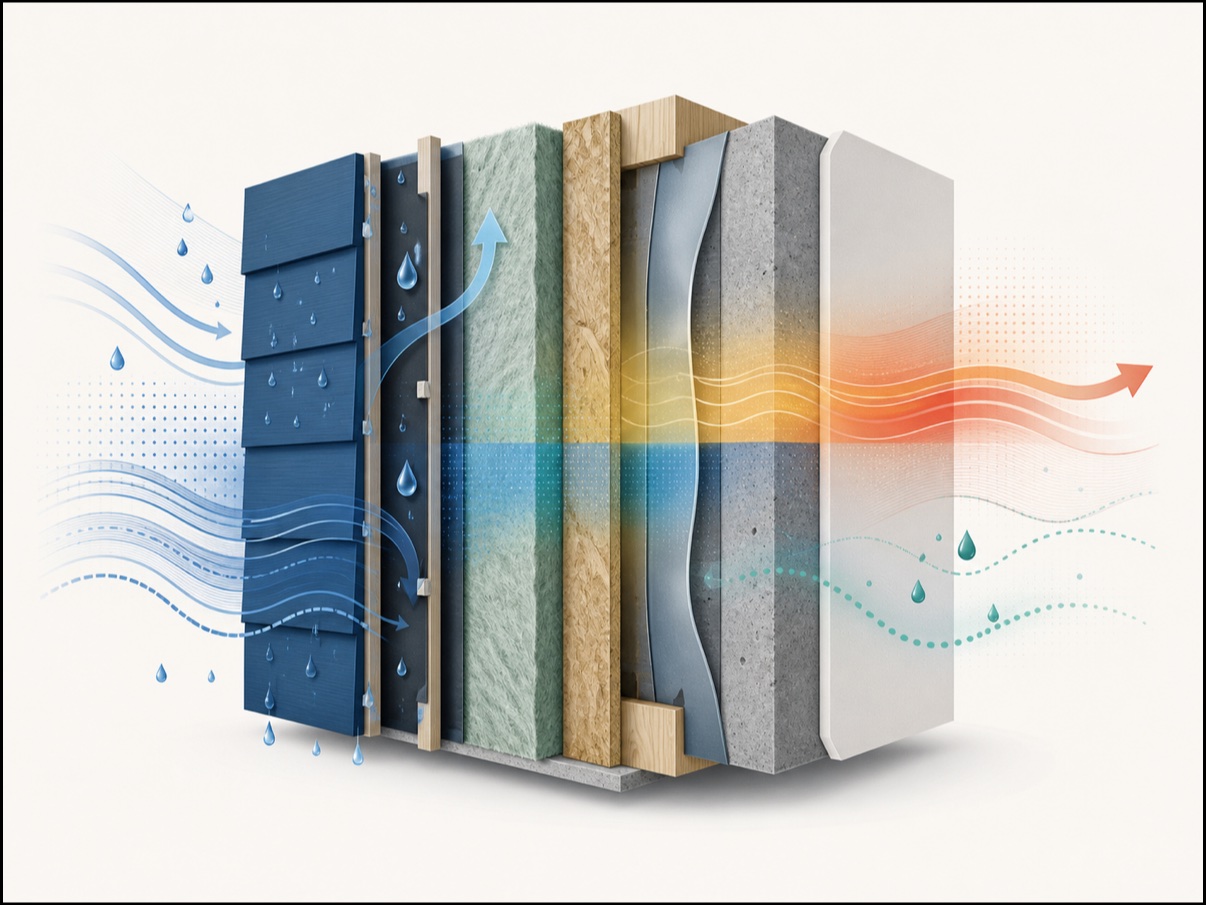
Materials and building physics: energy performance and moisture-related degradation
Building materials continuously evolve under the effects of temperature variations, humidity, water infiltration, freeze-thaw cycles and natural aging. These phenomena simultaneously affect energy performance, assembly durability and occupant health.
This research stream aims to better understand how materials and building systems actually behave under Canadian climatic conditions. The work focuses on heat, air and moisture transfer, degradation mechanisms, the effects of energy retrofit measures, and the evaluation of new materials and construction techniques.
The objective is to produce knowledge that can improve building durability, resilience, energy performance and design.
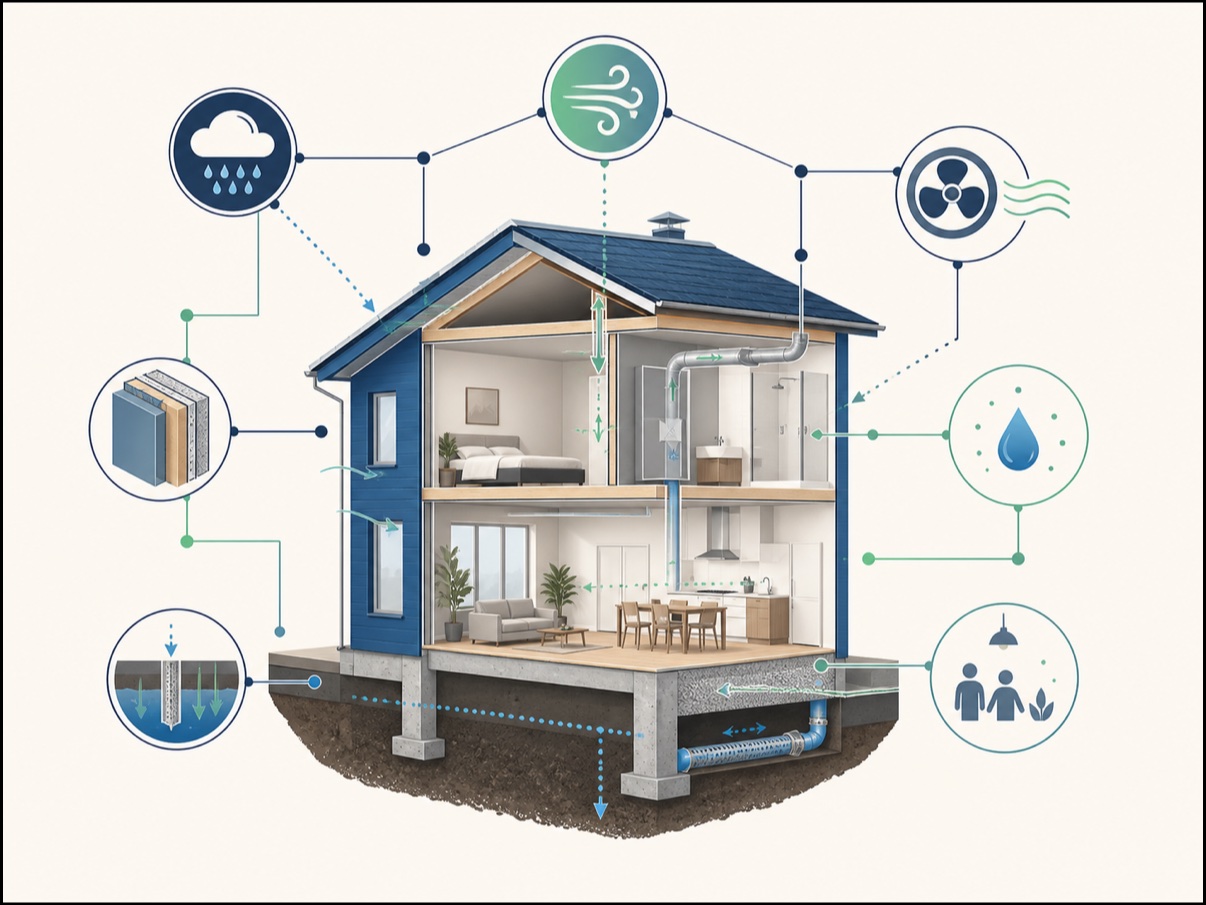
The building as a system: factors associated with mould growth
Mould problems observed in buildings rarely result from a single cause. They emerge instead from interactions among the building envelope, mechanical systems, materials, climatic conditions, building uses and occupant behaviour. Understanding these interactions is essential for rigorous diagnosis and durable interventions.
This research stream takes a systems approach to identify, characterize and quantify the factors that influence the appearance and growth of mould. The work focuses on air, heat and moisture transfer, water infiltration, thermal bridges, ventilation, building operating conditions and the interactions among these parameters.
The research draws on building inspection data, instrumented measurements, laboratory analyses, numerical simulations and statistical analyses. It aims to improve diagnostic methods, deepen understanding of building degradation mechanisms, and develop evidence-based prevention and rehabilitation approaches.
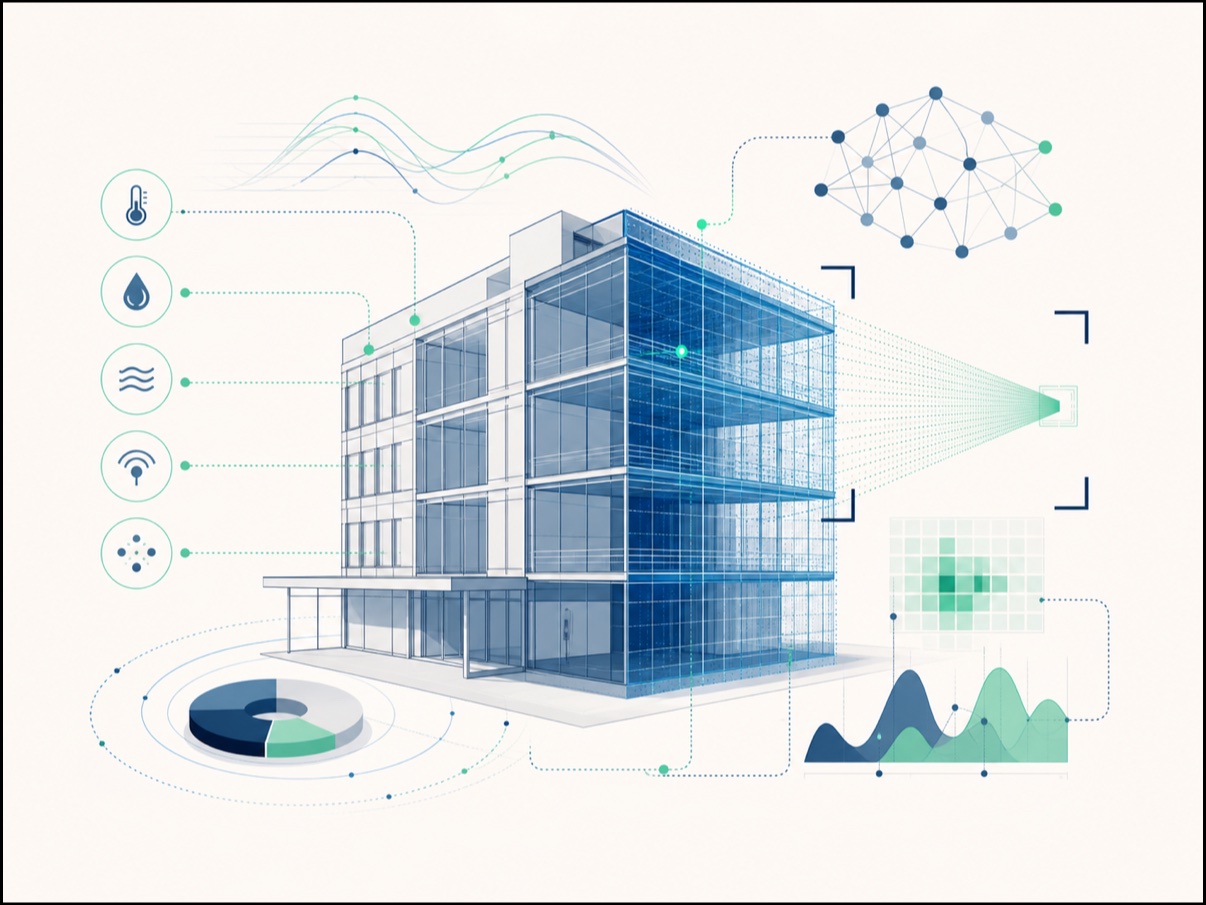
Data science, artificial intelligence and digital tools applied to buildings
The building industry produces a considerable amount of data every day from inspections, energy assessments, indoor air quality studies, reserve fund studies, building systems and operating activities. Long underused, these data now represent a strategic resource for understanding the building stock and supporting evidence-based decisions. At Services ecoPlus, this work draws on more than 15,000 reports covering more than 15 years of longitudinal data across the residential, commercial, industrial and institutional sectors. The corpus includes reports on energy efficiency, indoor air quality, mould and material characterization involving asbestos and lead.
This research stream focuses on developing and applying data science, artificial intelligence and digital tools to improve building analysis, diagnosis and management. The work includes automated data extraction, specialized software development, large-dataset analysis, predictive modelling, large language models (LLMs), computer vision, decision-support systems, and methods for turning technical and business data into actionable knowledge.
The objective is to develop tools and methods that improve analytical quality, automate repetitive tasks, support decision-making and advance knowledge in the building field.
Scope of applied research
From matter to evidence-based decisions
Joint analysis of matter, the building as a system, and data connects physical mechanisms observed in the field with operating conditions and technical decisions. This approach supports transferable knowledge, improved diagnostic methods, and evidence-based prevention and rehabilitation strategies.
Understanding Building Systems
Studying materials, transfers and interactions among components helps characterize the causes of problems observed in buildings more precisely.
Evidence-Based Data
Recommendations draw on field observations, measurements, analyses and documented scientific interpretation.
Prevention
Analyzing trends and degradation mechanisms helps identify emerging risks and guide preventive interventions.
Knowledge Transfer
Each project enriches the data corpus and supports the evolution of methods, analytical tools and building-science practices.
An Integrated Approach to Building Science
By connecting field observations, systems analysis and digital tools, Services ecoPlus contributes to a more rigorous understanding of building performance, health and durability.
Collaborate on Applied Research
Services ecoPlus invites researchers, institutions and building-sector organizations to collaborate on work involving materials, building systems and data analysis. Partnerships may include applied research projects, governed data sharing or methodological development, with appropriate confidentiality and scientific rigour.